

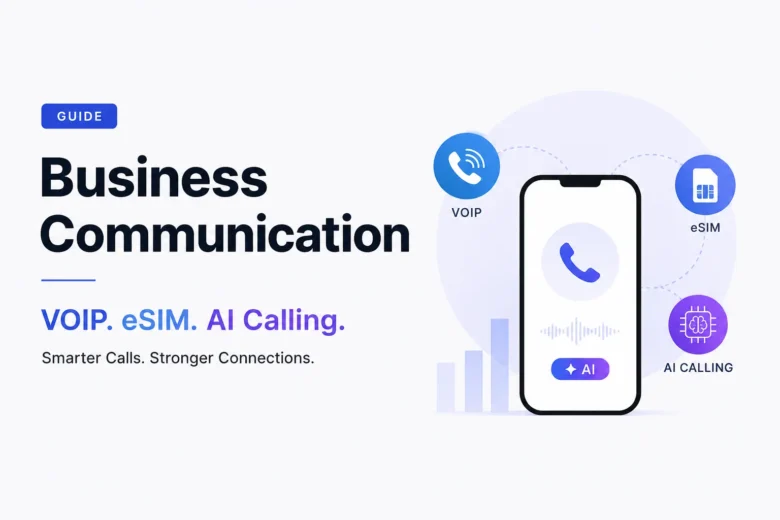
If you’re still running your business on a landline or juggling five different apps just to make one phone call, you’re bleeding money and time you don’t need to lose. Business communication has changed fast, and it’s not slowing down. The global VoIP services market was valued at roughly $201.97 billion in 2026 and is expected to climb to $472.21 billion by 2033, growing at a 12.9% annual rate according to Coherent Market Insights. That’s not a small shift. That’s an entire industry moving away from copper wires and toward the cloud.
In this guide, I’ll walk you through everything that matters right now: VoIP phone systems, wholesale VoIP and wholesale voice calling, virtual SIM solutions, white-label eSIM apps, AI outbound calling, number porting, and team communication apps. No fluff, just what you actually need to know before you pick a provider or rebuild your phone setup.
Why Businesses Are Ditching Traditional Phone Lines
Traditional PBX systems and copper lines are aging out fast. Carriers are winding down legacy services, and the hardware costs keep climbing every year. Meanwhile, companies that switch to a modern VoIP phone system report telecom cost reductions of up to 50%, according to industry data from SkySwitch. That’s a real number, not a sales pitch.
Here’s what’s driving the shift:
- Remote and hybrid teams need calling tools that work from anywhere, not just a desk phone
- Customers expect to reach a business through voice, text, and chat, and they expect it to feel connected
- AI-powered features like call transcription and smart routing are now baseline expectations, not add-ons
- Cloud-based systems scale instantly, while old hardware requires physical upgrades
North America still leads global VoIP adoption, holding around 36.8% of the market share in 2026, largely thanks to strong broadband infrastructure and fast enterprise digitization.
What Is VoIP Calling and How Does It Actually Work?
VoIP calling simply means your voice gets converted into data packets and sent over the internet instead of through a traditional phone network. No copper wires, no landline contracts, no rigid infrastructure. A good VoIP provider handles the routing, call quality, and uptime so your team just picks up the phone (or app) and talks.
Modern business phone systems built on VoIP calling typically include:
Core Features You Should Expect
| Feature | What It Does |
|---|---|
| Call routing | Sends calls to the right department or agent automatically |
| Call history | Logs every inbound and outbound call for review and reporting |
| Voicemail to text | Converts voicemails into readable messages instantly |
| CRM integration | Syncs calls directly with your sales or support pipeline |
| Multi-device access | Works on desk phones, laptops, and mobile apps at once |
The market for cloud-based contact center infrastructure built on VoIP is expected to grow 26% between 2024 and 2029, so this isn’t a passing trend. It’s becoming the default.
Business Phone Numbers and Virtual SIM Solutions
Getting local or toll-free business phone numbers used to mean waiting weeks and dealing with a carrier’s paperwork. Now, most VoIP providers let you spin up a number in minutes, whether you need a local presence in a new city or a toll-free line for customer support.
This is where virtual SIM solutions come in too. Instead of relying on a physical SIM card tied to one device or one country, virtual SIM technology lets you assign numbers and connectivity digitally. This matters a lot for businesses with remote teams, international staff, or sales reps who travel constantly.
Number Porting: What You Need to Know
Number porting is the process of moving your existing business number from one provider to another without losing it. Customers, partners, and vendors already have that number saved, so keeping it during a switch matters more than people realize. A smooth port usually takes anywhere from a few days to about two weeks, depending on your current carrier and the type of number involved (local, toll-free, or international).
Before you switch providers, check for these things:
- Confirm your current account is in good standing (no unpaid balances that could block the port)
- Get your account number and PIN from your existing provider
- Ask your new VoIP provider for a clear porting timeline in writing
- Keep your old service active until the port is fully confirmed
The Rise of eSIM: White-Label Apps and Business Use Cases
eSIM adoption is accelerating quickly. The global eSIM market is projected to grow from around $23.1 billion in 2026 to $66.3 billion by 2033, a CAGR of 16.3%, according to Coherent Market Insights. GSMA Intelligence also reports that global eSIM smartphone penetration is expected to hit 10% in 2026, up from just 5% in 2025.
For businesses in telecom, travel, or connectivity services, launching a white-label eSIM app has become a real growth opportunity. Instead of building carrier infrastructure from scratch, a company can license eSIM technology, brand it as their own, and sell data and voice plans directly to customers. This model works especially well for:
- Travel companies offering instant international connectivity
- Telecom resellers who want their own branded mobile product
- Businesses managing fleets of connected devices across regions
Travel is actually the breakout use case here. Retail spending on travel eSIM services jumped roughly 165% between 2023 and 2025, and over half of eSIM users say international travel was the reason they tried the technology in the first place.
Wholesale VoIP and Wholesale Voice Calling Explained
If you’re a reseller, carrier, or a company routing large volumes of calls, wholesale VoIP is where the real cost savings live. Instead of paying retail per-minute rates, businesses buy call capacity in bulk from a wholesale voice calling partner and route traffic through their network at a much lower cost per minute.
Wholesale VoIP vs Retail VoIP: A Quick Comparison
| Factor | Wholesale VoIP | Retail VoIP |
|---|---|---|
| Who it’s for | Carriers, resellers, large call centers | Individual businesses, small teams |
| Pricing model | Bulk, per-minute rates | Flat monthly plans |
| Call volume | High volume, millions of minutes | Low to moderate volume |
| Setup complexity | Requires technical routing knowledge | Plug-and-play |
A reliable VoIP provider offering wholesale voice calling should give you clear rate decks, strong route quality, and real-time monitoring so dropped calls or poor audio don’t cost you customers.
AI Outbound Calling: The Next Big Shift
AI is no longer optional in business phone service. Nextiva’s 2025 CX research found that 92% of organizations have already adopted some form of AI in customer experience, and conversational AI is expected to cut contact center labor costs by roughly $80 billion. That’s a massive shift in how outbound calling gets done.
AI outbound calling now handles tasks that used to require full call center teams, including appointment reminders, lead qualification, follow-up calls, and basic customer surveys. The technology has gotten good enough to hold natural conversations, detect voicemail, and route complex calls to a human agent when needed. For businesses running high call volumes, this cuts costs while keeping response times fast.
Platforms like InterOps are built around exactly this kind of unified approach, combining VoIP calls, number management, and AI-driven calling workflows in one place instead of forcing teams to stitch together five separate tools.
Team Communication Apps: Keeping Everyone Connected
A phone system alone isn’t enough anymore. Teams need a proper Team Communication App that brings calls, messaging, call history, and file sharing into one dashboard. Mordor Intelligence puts the unified communications market at $56.14 billion in 2025, growing at a 25.65% CAGR, which tells you how fast companies are consolidating their tools.
When comparing team communication apps, look for:
- Shared call history across the whole team, not just individual users
- Direct integration with your VoIP phone system
- Mobile and desktop apps that stay in sync
- Simple permission controls for who can see what
How to Choose the Right VoIP Provider
Picking a provider isn’t just about the monthly price. Here’s a simple checklist before you commit:
- Check their uptime guarantee (look for at least 99.9%)
- Ask about number porting timelines and any hidden fees
- Test call quality with a trial before signing a contract
- Confirm CRM and team app integrations work with your current tools
- Review their AI calling features if outbound volume matters to you
- Read the fine print on wholesale rates if you’re routing high call volumes
Conclusion
Business communication in 2026 isn’t just about making calls anymore. It’s about connecting VoIP calling, business phone numbers, virtual SIM solutions, eSIM technology, and AI outbound calling into one system that actually works for your team. Whether you’re a small business switching from a landline, a reseller looking into wholesale VoIP, or a company exploring a white-label eSIM app, the tools available right now are more capable and more affordable than ever. Start with what your team actually needs, test before you commit, and make sure whatever VoIP provider you choose can grow with you instead of holding you back.
Frequently Asked Questions
1. What’s the difference between VoIP and a traditional phone line?
VoIP sends your voice over the internet as data, while traditional phone lines use physical copper wiring. VoIP calling is generally cheaper, more flexible, and easier to scale as your team grows.
2. How long does number porting usually take?
Most number porting requests take anywhere from a few days to about two weeks, depending on your current carrier and whether the number is local, toll-free, or international.
3. Is wholesale VoIP only for large call centers?
Wholesale VoIP works best for businesses with high call volumes, like carriers, resellers, and large support teams. If your call volume is lower, a standard retail VoIP plan usually makes more sense.
4. Can a white-label eSIM app really work for a small business?
Yes, as long as you partner with a provider that handles the underlying infrastructure. You focus on branding and customer experience while the technical connectivity runs in the background.
5. How accurate is AI outbound calling compared to a human agent?
Modern AI outbound calling handles routine tasks like reminders and lead qualification well, and can detect voicemail and hand off complex conversations to a human agent when needed. It’s not a full replacement for nuanced conversations, but it saves significant time on repetitive calls.
6. Do I need a separate team communication app if I already have VoIP?
Not necessarily. Many VoIP providers now bundle team messaging, shared call history, and collaboration features directly into their platform, so check what’s included before paying for a separate tool.
